Published 26.11.2026. | Tena Mur
The Municipal State Attorney’s Office in Split, Croatia, filed an indictment on 13 November against 22 members of the Torcida supporters’ group for chanting Nazi and antisemitic slogans ahead of a football match between local side Hajduk Split and Dutch club Ajax Amsterdam.
The defendants are accused of publicly expressing contempt for Jews and urging others to join in chants including “Trample, trample the Jews!” and “Rise up, Adolf!” while raising their right arms in salute. The chanting allegedly came from the front rows of a supporters’ march ahead of the Conference League match on 15 October. The chants also referred to blast furnaces, coke and Anne Frank (1929–1945), a girl who died because she was Jewish and became a worldwide symbol of the suffering of innocent children in the Second World War.
The Municipal State Attorney’s Office in Split has requested prison sentences ranging from ten months to two years for public incitement to violence and hatred. It is seeking the longest sentence for a defendant who already faces proceedings over the disruption of an event in the Days of Serbian Culture programme, organised by the Serbian Cultural Society “Prosvjeta” in Split on 3 November 2025. On that occasion, a group of around 50 young men dressed in black stormed the premises of the Blatine city district, shouting the Ustaša salute “Za dom spremni” (“For the Homeland, Ready”).
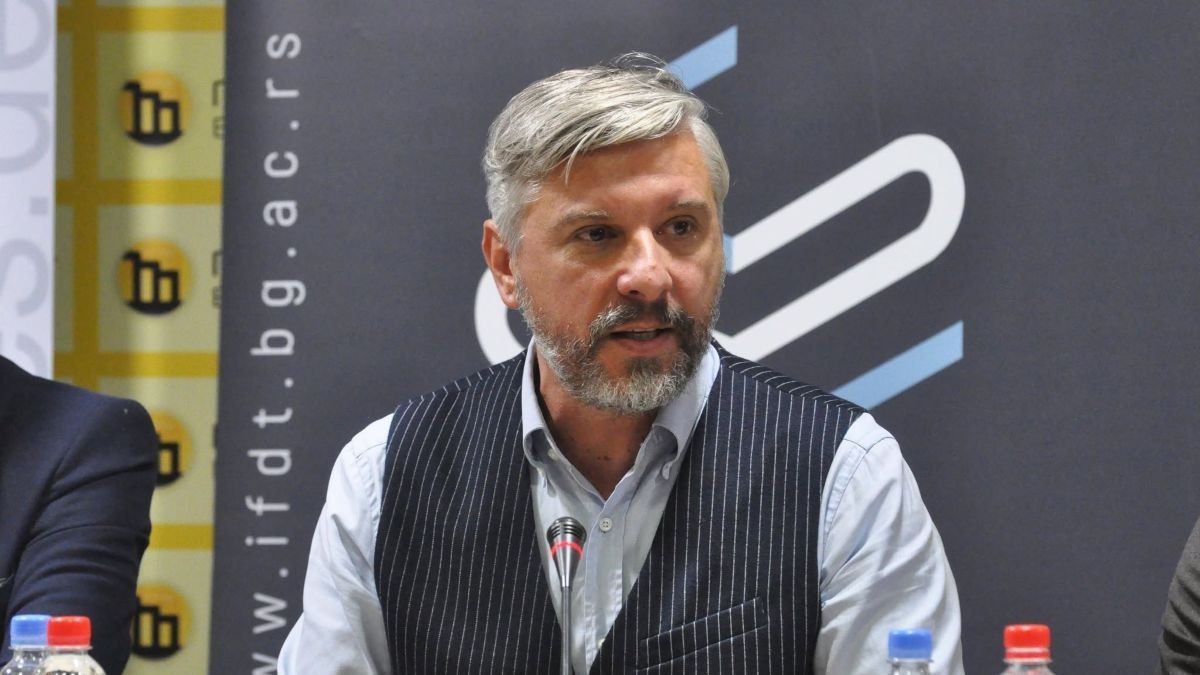
Incidents like these raise questions about how societies deal with their past and routinely provoke strong reactions across the region. They are the starting point for our conversation with historian Hrvoje Klasić, a professor at the University of Zagreb’s Faculty of Humanities and Social Sciences whose research focuses on contemporary Croatian and world history, particularly historical revisionism.
***
Did you see what happened in Split as news, or simply as another symptom of the state of society?
I’ve spent the past twenty years or so looking at how we deal with the past and how we avoid confronting it, so of course what happened in Split neither shocked nor surprised me. Perhaps what surprised me was that it went a step further. People from outside Croatia may not realise that we don’t really see Holocaust denial here, either in public discourse or in society more broadly. Quite the opposite. Holocaust remembrance has been part of the school curriculum for two or three decades, and the public broadcaster always devotes considerable attention to it.
At the same time, though, the Ustaša movement is being downplayed in Croatia. That has less to do with tolerating the killing of Jews and more to do with anti-Serb sentiment. There’s something distinctive about Croatia in this respect. The attitude is, “Yes, yes, of course we’ll mark Holocaust Remembrance Day when it comes to Auschwitz and the Nazis.” But when it comes to the Ustaša, especially what they did to Serbs, the situation changes.
What happened in Split was a first, really, and an isolated case. Unlike, say, Hungary, Germany or Austria, we hadn’t seen antisemitic slogans or messages in public before. In that sense, it took us all by surprise.
Of course, we also need to put the incident in context. This was a group of supporters of a Croatian club playing a Dutch club whose fans call themselves Jews. That led to Ajax supporters being associated with Jews and gas chambers, which of course is completely unjustifiable.
In short, the Ustaša movement is downplayed in Croatia, and people question the criminal nature of the regime when it comes to its treatment of Serbs. But until now, no one has publicly spoken about or called into question the genocide of the Jews.
How do you think the Croatian authorities, the academic community, civil society and the media responded to an incident whose significance reaches beyond Croatia and even beyond the region?
Glorifying defeated criminal regimes from the Second World War is nothing new in Croatia. I’d say the response this time was much clearer, louder and sharper than usual, and that had to do with what was chanted. When those young men shout “Za dom spremni,” you don’t get this kind of response. But when Jews and Hitler are mentioned, people say, “Now we have to do something.”
I’d say the media handled it very well. The media in Croatia are free and, in this respect, largely opposed to nationalism. As for politics, most of the key players, including the Croatian Democratic Union (HDZ), condemned what happened. Some members of the far-right Homeland Movement tried to play it down, of course, but basically no one said it was normal.
In that sense, the response followed a familiar pattern. You have outspoken people like me, journalists and even some politicians who have been unequivocally condemning incidents like this for years. Then you have the right, which generally tries to play down the Ustaša movement. This time, though, they had no room to do that because the chants invoked Hitler, gas chambers and Jews.
Did anyone try to justify what happened in Split or link it to the current situation in the Middle East and what is happening in the Gaza Strip?
No, there was none of that, and that’s interesting. In Croatia, the right is much more supportive of Israel, while the left is broadly pro-Palestinian, you could say, without any antisemitism. The Croatian right is much quieter about what’s happening in Israel and Palestine. So this incident was certainly not motivated by that, and we haven’t seen an increase in antisemitism in that context over the past two or three years either.
How would you describe attitudes towards the past and towards antisemitism in what is now called the Western Balkans? Is there a problem in our societies or in our education systems that makes incidents like the one in Split more likely to recur? How do we make sense of someone resorting to slogans like these in 2026?
As I said, unfortunately this isn’t unique to our part of the world. I’d say antisemitism is far less pronounced here than in the rest of Europe, particularly on the European right. That may be hard for someone from outside the region to understand. I know it may sound contradictory, but glorifying the Ustaša here is generally driven by hostility towards Serbs rather than by antisemitism.
Confronting the past is a separate issue. Of course, glorifying the Chetnik movement, the Ustaša or the Handschar Division has no place in the twenty-first century. Unfortunately, we’re hardly alone in that respect. I’d say there’s far too much of it across Europe.
As far as education is concerned, at least in Croatia, the education system is in much better shape than society at large. There are no textbooks that portray the Ustaša as the good guys, play down the number of victims at Jasenovac, or present Ante Pavelić and other Ustaša figures as national heroes. You don’t find that.
But I keep saying that education is no longer the main influence on how people form their opinions. Young people now get far more of their information from social media and celebrities than they do from their teachers.
Confronting the past is complicated because it’s no longer just a matter for the education system. Politicians, intellectuals, singers, actors, athletes and many others all shape how we think about it. We can’t influence them in the way we might be able to influence education.
So who is educating our children?
I don’t know why people who work on these issues keep insisting on education. We’re talking about just two history lessons a week in primary and secondary school, and in some secondary schools, even fewer. Education on its own is no guarantee. It isn’t that bad, though of course it could be better. When you look at the textbooks in Croatia, they really aren’t that bad. But schools can’t compete with all the other influences that shape how people see the past.
I’m going to take a pretty radical position here. I’ve spent about twenty years fighting efforts to play down the past, nationalism, the glorification of the Ustaša and all the rest. I thought we could count on education, access to information, common sense and a sense of right and wrong. But we lost that battle.
I’d follow Austria’s example. Two or three years ago, Austria raised the maximum fine for glorifying Nazi symbols to €20,000. I’d do the same. Make it €10,000, even, and let the Ustaša and Chetniks fill our state coffers. But that’s not going to happen. We saw what happened a few years ago in Bleiburg when a Croatian man who had shouted Ustaša slogans was brought before a court. He started crying and pleading, saying he’d never do it again.
There’s no point in relying on reason alone anymore. We need to take a tough line and enforce penalties. Sometimes that’s the only way to restore order, so let’s try it.
So there is room for legislation.
Of course. But to have effective laws, you have to be sure that the conduct in question really should be punishable. In Croatia, for thirty years now, the difficulty hasn’t been proving whether something is associated with the Ustaša. The difficulty is whether people are bothered by it. If you aren’t convinced that the Chetniks were criminals who served the occupiers and collaborated with the Nazis, the Fascists and the Ustaša, or that the Ustaša committed genocide against Serbs, Jews and Roma, if you think none of that is true, why would the courts and the police respond in the way I think they should? It’s a vicious circle.
In Serbia, the Chetniks have come to be regarded as one of the anti-fascist movements. In Croatia, the Ustaša are put on the same footing as the Partisans. Under those circumstances, passing and enforcing stricter laws is obviously very difficult.
So in the end, it comes down to state ideology.
Yes, exactly.
_ _ _
Funded by the European Union. The views and opinions expressed are those of the authors and do not necessarily reflect those of the European Union or the European Education and Culture Executive Agency (EACEA). Neither the European Union nor EACEA can be held responsible for them.
Image source: MEDIJA CENTAR BEOGRAD.
